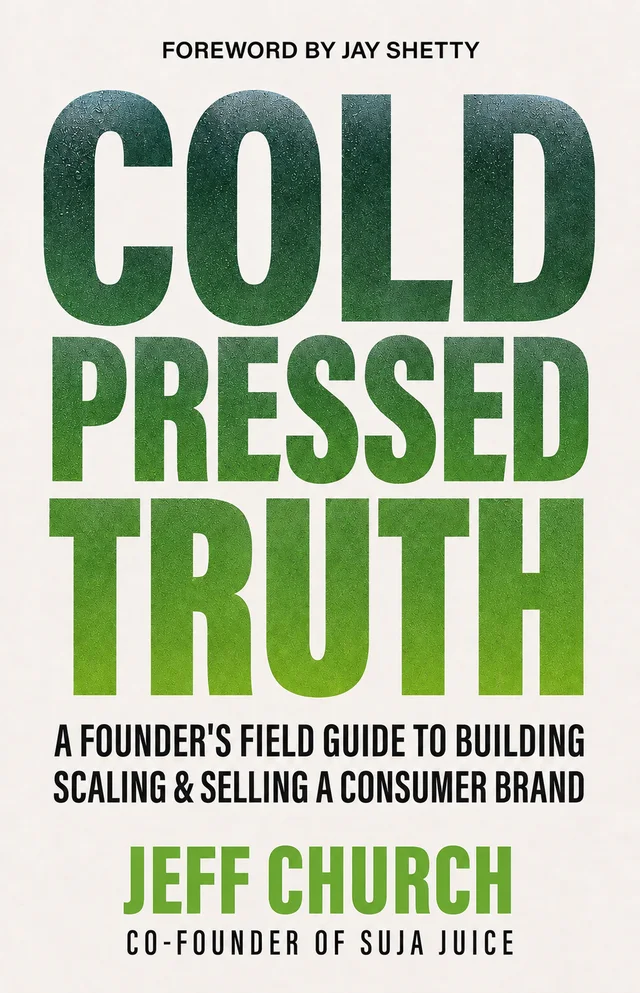
The Cold-Pressed Truth
A founder's field guide to building, scaling and selling a consumer brand.
By Jeff Church · Foreword by Jay Shetty
Start the climb Synopsis
Every chapter is a place on the map, labeled with its number. Tab between them and press Enter to open one. Arrow keys move the map.

The route
Twenty-three chapters in three stages, from base camp to the summit.
Trailhead Before chapter 1
-
Foreword, Preface and a Gift
On Kilimanjaro, the guides started calling me Babu. It's Swahili for grandpa. I was the slow one, handing out advice nobody asked for. This book is the guide I couldn't find when I started, from a founder who has done it eight times. Jay Shetty, who worked alongside me, wrote the foreword. And because I wanted to hand you things, not just tell you things, the book comes with a free toolbox: models, workshops and a community of founders who answer each other's questions.
Jay Shetty's foreword, the Kilimanjaro trail where the guides started calling Jeff Babu, and the free toolbox that comes with the book.
- Jay Shetty on why this is essential reading for founders in consumer industries, and what it was like to work alongside Jeff.
- Babu is Swahili for grandpa. On Kilimanjaro it meant the slow one a few steps ahead, handing out advice nobody asked for.
- A gift: the free toolbox of models, workshops, the CPG Founders Club and a trial of Babu AI, at cpgfoundersgroup.com/toolbox.
Kilimanjaro, where Babu got his name
Base camp Part I · Building a Strong Foundation
-
The Founder's DNA
At seventeen I was wide open in the end zone, and I didn't raise my hand. I was afraid of dropping the ball. We lost, and I replayed those three seconds for twenty years. Courage doesn't make the fear go away. It stops fear from making the final call. At thirty-eight, with a newborn at home, I decided mediocrity scared me more than failure. Founders are made, not born. This chapter is about the six traits worth building on purpose: curiosity, resilience, a bias for action, financial discipline, integrity and the ability to learn.
Opens on the afternoon of July 3, 2018, then rewinds to a high school end zone and a three-second failure of nerve. Why founders are made rather than born, and the six traits worth building on purpose.
- Courage doesn't make the fear go away. It stops fear from making the final call.
- Six traits to build on purpose: curiosity, resilience, a bias for action, financial discipline, integrity and the ability to learn.
- At 38, with a newborn at home, Jeff decided mediocrity scared him more than failure.
The Lakewood Rangers end zone
-
Pre-Launch Preparation
Before you quit your job or ask anyone for money, answer the hard questions in writing. Do you have the capacity? Can you carry the risk? Who will support you? Plan on something like two hundred to three hundred fifty thousand dollars of early capital. Then let taste and repeat rate tell you the truth. If fewer than one in ten buyers come back, find out why before you scale. Dream boldly. Plan soberly.
The honest questions to answer before you quit your job or ask anyone for money: capacity, risk, support, capital, real demand and taste. Includes the entrepreneurial readiness assessment.
- “Dream boldly. Plan soberly.”
- Expect to need something like $200,000 to $350,000 of early capital.
- Taste comes first, then repeat rate. If fewer than one in ten buyers come back, find out why before you scale.
-
Pre-launch Roadmap with Timeline and Budget
Here's the plan I wish I'd had: twelve months, eight phases and about two hundred fifty thousand dollars from idea to first production run. Then the Rule of Twos. Everything takes twice as long and costs twice as much as your spreadsheet says. I learned that the day a Whole Foods buyer asked me for a HACCP plan and I had no idea what it was. Own your formula, and know exactly what your co-manufacturer makes on you.
A twelve-month, eight-phase plan on a budget of about $250,000, the Rule of Twos, and the day a Whole Foods buyer asked Jeff for a HACCP plan he'd never heard of.
- From idea to first production run: nine to twelve months and about $250,000.
- The Rule of Twos: everything takes twice as long and costs twice as much as the spreadsheet says.
- Own your formula, and know your co-manufacturer's margin.
A buyer asks for a HACCP plan
-
The M.A.P. Framework for Assessing Your Category
Market, audience, positioning. Size your arena like nesting dolls: industry, category, segment, niche. Then name your customer. “Health-conscious consumers” isn't an audience. It's a placeholder. Find the real person, what they buy and why. Finally, write your position in one line a stranger understands: we're the only one that does this, for these people.
Market, Audience, Positioning. Map your arena from industry down to niche, define a customer far sharper than "health-conscious," and write the one-line position that passes the stranger test.
- Size the arena like nesting dolls: industry, category, segment, niche.
- “‘Health-conscious consumers’ is not an audience. It's a placeholder.”
- The position in one line: we're the only X that does Y for Z.
-
Stage-Gate Process
Big consumer companies kill weak ideas early, and they do it with stage gates. Gates filter. Stages build. Every gate asks one question: does this deserve more investment? You don't need their committees, just their discipline. The hardest part is walking away before sunk cost makes the decision for you. A year spent on the wrong idea is a year you don't get back.
How large CPG companies kill weak ideas early, adapted for founders who can't afford to spend a year on the wrong opportunity.
- Gates filter, stages build.
- Every gate asks one question: does this deserve more investment?
- Walk away before sunk cost makes the decision for you.
-
Life Stages of a Brand
Every brand goes through four stages. Stage one proves you can launch. Stage two proves you deserve to grow. For Suja that meant a green juice, a name we found over lunch at Whole Foods, and fifty stores in Southern California in 2012. A competitor's bottle at Jimbo's taught us about high pressure processing. And a one million dollar spoilage loss taught me to put every agreement built on trust in writing. If fewer than one in five customers come back, that's churn, not a business.
The four stages from creation to scale, with Suja as the case study: the green juice, a name found over lunch at Whole Foods, the discovery of High Pressure Processing, and a $1 million spoilage lesson.
- Stage one proves you can launch. Stage two proves you deserve to grow.
- Under 20 percent repeat is churn, not a business.
- The $1 million spoilage lesson: put every agreement built on trust in writing.
2012: launch in 50 Whole Foods stores
-
Fundraising
I've raised money in more than forty rounds, and it comes down to an eight-step process. Raise for eighteen months of runway. Soft-circle a quarter of the round before you announce it. Hold dilution near fifteen to twenty percent a round. And mind the psychology of it. Enthusiasm attracts. Desperation repels.
Forty-plus rounds distilled into an eight-step process: runway, soft-circling, decks, SAFEs, valuation and the psychology of asking for money.
- Raise for 18 months of runway.
- Soft-circle a quarter of the round before you announce it, and hold dilution near 15 to 20 percent a round.
- “Enthusiasm attracts. Desperation repels.”
-
The X-Factor of Culture and People
Culture isn't a poster on the wall. Write the scorecard before you write the job post. Make decisions with what I call cul-de-sac management: everyone gets input, one person owns the call. When something breaks, protect the customer first. And don't take yourself too seriously. On our first delivery to a Whole Foods distribution center, I drove a forklift I had no business operating and sliced into a pallet of beet juice. It did more for our culture than any speech.
Hiring scorecards, equity as culture, Cul-de-sac Management, and the morning the CEO speared a pallet of beet juice with a forklift.
- Write the scorecard before you write the job post.
- Cul-de-sac Management: everyone gets input, one person owns the call.
- When something breaks, protect the customer first.
The forklift and the beet juice
-
Ten Startup Misconceptions That Can Crack Your Foundation
Some beliefs sound reasonable and quietly crack your foundation. Take the famous statistic that most startups die in their first year. The real number is closer to twenty-one and a half percent, not ninety-five. Coming from outside consumer goods isn't disqualifying either. The comfortable beliefs are the dangerous ones, because nobody bothers to check them.
The beliefs that sound reasonable and quietly sink founders, starting with the myth about how many startups fail in their first year.
- The first-year failure rate is closer to 21.5 percent than the 95 people like to quote.
- Coming from outside CPG is not disqualifying.
- The comfortable beliefs are the ones that crack foundations.
The climb Part II · Scaling the Engine
-
Scaling Quickly Without Losing Control
Scaling feels like chaos because it is. Push each decision to the person closest to it. Choose good over perfect, even when half your Costco rotations don't work. When Trader Joe's called about celery juice, we had it on shelves nationwide in under six weeks.
Embracing chaos, pushing decisions down, choosing good over perfect, and getting celery juice from a Trader Joe's phone call to national shelves in under six weeks.
- Push each decision to the person closest to it.
- Good beats perfect, even when half the Costco rotations don't work.
- Celery juice went from a phone call to shelves nationwide in under six weeks.
Celery juice in under six weeks
-
Building an Engine That Lasts
Decide what to own and what to outsource, and revisit it as you grow. Then find the one constraint that limits everything else and solve it first. For Suja, that was shelf life. Our gross margin climbed from about twenty-eight percent to nearly fifty, and that changed everything. Revenue is exciting. Gross margin is transformational.
What to own and what to outsource, solving the one constraint that limits your growth, and the climb from about 28 percent gross margin to nearly 50.
- Decide what to own and what to outsource, and revisit it as you grow.
- Find the one constraint that limits growth and solve it first. For Suja, it was shelf life.
- “Revenue is exciting. Gross margin is transformational.”
-
Winning the Shelf
You never own the shelf. You keep earning it. Learn the syndicated data. Know your velocity against the retailer's median before the buyer brings it up. And make the category manager's job easier, because that's how you stop being just another vendor.
Category managers, syndicated data, velocity against the retailer's median, and why the shelf is never really yours.
- You never own the shelf. You keep earning it.
- Know your velocity against the retailer's median before the buyer brings it up.
- Make the category manager's job easier and you stop being just another vendor.
-
The Art of the Pivot
In seven years we launched two hundred seventy-five products. Fifty-five survived. That's the job. Run Plan B alongside Plan A, not after it fails. Know your hero SKU, the one that should outsell the rest of the line by thirty percent or more. And learn to tell disruptive innovation from churn, because from the inside they can look the same.
Hero SKUs, 275 launches in seven years, always having a Plan B, and where disruptive innovation ends and churn begins.
- 275 launches in seven years. 55 survived.
- A hero SKU should outsell the rest of the line by 30 percent or more.
- Run Plan B alongside Plan A, not after it fails.
275 launches, 55 survivors
-
Validation Through Strategic Partnerships
In 2015, Coca-Cola invested in Suja at a three hundred million dollar valuation. Every strategic deal needs a champion inside the other company. We built ours in two steps: an investment now, an option to buy the rest later. We even paused the deal to fix a quality issue first. And I fought for the angel investors who believed in us before anyone else did.
Inside the Coca-Cola deal: two-step structures, internal champions, pausing a deal to fix a quality issue, and fighting for the angel investors who got there first.
- Every strategic deal needs a champion inside the other company.
- Two steps: an investment now, an option to buy the rest later.
- Suja paused the Coca-Cola deal to fix a quality issue first.
2015: Coca-Cola invests
-
Collaborative Retail Relationships
Retail partnerships are built on trust, and sometimes on home-cooked dinners. The order you enter retailers matters: Whole Foods, Target, Costco and Kroger before Walmart. Help the retailer grow the category, not just your brand. And build pack sizes for each channel, because every one of them wants something different.
How Suja built real partnerships with Whole Foods, Costco, Target, Walmart and Trader Joe's, why the order you enter retailers matters, and the home-cooked dinners that built trust.
- Sequence matters: Whole Foods, Target, Costco and Kroger before Walmart.
- Help the retailer grow the category, not just your brand.
- Every channel wants its own pack sizes.
-
Coca-Cola's Fateful Decision
July 3, 2018, five o'clock. Coca-Cola called to say they wouldn't buy the rest of Suja. Nearly forty million dollars of debt was due in October, and some weeks we had under a hundred thousand in the bank. The lesson I took from it is about margin. Under thirty percent gross margin isn't sustainable. Aim for forty by the end of year two. Hope is not a forecasting model.
The call, the debt, weeks with under $100,000 in the bank, and the margin lesson that changed how Jeff builds every brand since.
- Coca-Cola passed on its option, and nearly $40 million of debt was due in October.
- Under 30 percent gross margin is unsustainable. Aim for 40 by the end of year two.
- “Hope is not a forecasting model.”
July 3, 2018, 5:00 p.m.
-
A Pivot in Action
After the call came a down round, a fortune teller's prediction and the hardest pivot we ever made. Kombucha was earning about twelve percent margin. Wellness shots earned about sixty. So we changed the mix, and gross margin climbed from thirty-two percent to about forty. You can't cut your way to greatness.
A down round, a fortune teller's prediction, and how wellness shots at about 60 percent margins replaced kombucha at 12 and rescued the business.
- Kombucha earned about 12 percent margin. Wellness shots earned about 60.
- Gross margin climbed from 32 percent to about 40.
- “You can't cut your way to greatness.”
The fortune teller
The summit Part III · The Exit and Key Learnings
-
The Moment of Truth
In 2018 we lost ten million dollars. In 2019 we made three million in EBITDA. We cut marketing in half, and sales still grew. Fifteen buyers passed before the sale. Part of the turnaround was knowing when to hand the CEO role to someone new.
From a $10 million loss to profitability in a year, fifteen buyers who passed, stepping aside as CEO, and the sale.
- From a $10 million loss in 2018 to $3 million of EBITDA in 2019.
- Marketing was cut in half, and sales still grew.
- Fifteen buyers passed before the sale, and Jeff handed the CEO role to a new leader.
2019: back to profit
-
Personal Reflections on Leading a Startup
Building a company costs more than money. It can cost your health, your marriage and your time with family if you let it. The highs are higher and the lows are lower than anyone warns you. Talk openly with your spouse about the risk before you take it. Put your own oxygen mask on first. And yes, I'd still do it all again.
The good, the bad and the ugly: what building a company costs your health, your marriage and your family, and why Jeff would still do it all again.
- The highs are higher and the lows are lower than anyone warns you.
- Talk openly with your spouse about the risk before you take it.
- Put your own oxygen mask on first.
-
Babu's Field Guide for Startup Entrepreneurs
These are my fifteen rules for any startup in any industry. Make sure the math works. Revenue without margin is ego. You cannot out-market a mediocre product. And own the customer relationship, because everything else is rented land.
Fifteen rules for any startup in any industry, from making sure the math works to owning the customer relationship.
- “Revenue without margin is ego.”
- “You cannot out-market a mediocre product.”
- Own the customer relationship. Everything else is rented land.
-
Fatal Flaws and Recoverable Mistakes
I keep a private list of the mistakes that end companies. Contracts longer than a year. Auto-renewals. Personal guarantees. Formulas you don't own. Most mistakes you can survive. Running out of cash is the one you don't come back from.
Jeff's private list of the mistakes that end companies, like auto-renewing contracts, personal guarantees and formulas you don't own, and the ones you can survive.
- Watch for contracts longer than a year, auto-renewals and personal guarantees.
- Own your formula.
- Running out of cash is the mistake you don't come back from.
-
The Universal Principles For Any Startup
Ten truths hold in every industry. Cash is oxygen. Growth doesn't build strength, it reveals it. Everything takes longer than you think. And adaptation is not failure.
Ten truths that hold in every industry, from "cash is oxygen" to "it takes longer than you think."
- “Cash is oxygen.”
- Growth doesn't build strength. It reveals it.
- “Adaptation is not failure.”
-
The Journey & The Destination
Thirty years ago, flying into Seattle at night, I saw Mount Rainier lit by a full moon and promised myself I'd stand on top of it. Less than a year later, I did. Since then I've caught piranhas on the Amazon and flown to Kathmandu. Here's what the mountains taught me: you don't wait until you feel ready to start the climb. If you're wide open in the end zone, raise your hand.
Mount Rainier by moonlight, piranhas on the Amazon, a flight to Kathmandu, and why you start the climb before you feel ready.
- You don't wait until you feel ready to start the climb.
- Wide open in the end zone? Raise your hand.
Rainier, the Amazon, Kathmandu
-
Epilogue: Ringing the Bell
In May 2026, Suja Life rang the opening bell on Nasdaq. I watched from San Diego. The decision that saves a company is usually made eighteen months earlier, on an ordinary Tuesday. Build the company, but don't be the company. The bell is a moment. The work is the point.
Suja Life goes public in May 2026. Jeff on what he felt watching from San Diego, and the lesson he'd hand every founder about who you are without the title.
- The decision that saves you was usually made 18 months earlier, on an ordinary Tuesday.
- “Build the company, but don't be the company.”
- The bell is a moment. The work is the point.
May 2026: the opening bell
Plus Appendix A, A Founder's Field Guide to Essential Retail Metrics: velocity, ACV, TDPs, promotion lift and the rest of the language of retail, defined.
Every chapter on one pageAbout The Cold-Pressed Truth
By Jeff ChurchOut November 17, 2026 · Paperback and ebook
5:00p.m.
July 3, 2018
Coca-Cola was out. Now what?
Three years earlier, Coca-Cola had bought into Suja and taken an option on the rest. Then, the afternoon before the Fourth of July, the call came.
Six weeks earlier, Coke's management and HR teams had come by to talk through integration. Now, with Jeff's house full of family getting ready for the holiday, Coke said it would not be buying the company.
Suja was on track to lose about $10 million that year. Nearly $40 million of debt was due in October. Some weeks there was less than $100,000 in the bank. And the question Jeff couldn't shake wasn't about any of that. It was How did I let us get to this place?
| Summer 2018 | What came next |
|---|---|
| $10M on track to be lost that year | +$3M EBITDA the very next year |
| $40M in debt coming due in October | $300M roughly what the company later sold for |
| <$100K in the bank, some weeks | Nasdaq opening bell, May 2026 |
The Cold-Pressed Truth is the honest answer, and the playbook that came out of it.
No heat. No filler. Nothing added.
Cold-pressing skips the heat, so nothing good gets cooked out. Jeff wrote the book the same way.
You get the real numbers, the expensive mistakes and the frameworks that came out of them. You don't get the hype. He has started or acquired eight companies, hit five home runs and struck out three times, and he writes about the strikeouts as plainly as the wins. That's where most of the lessons were.
- How to tell whether you're ready to take the plunge
- How to size your category with the M.A.P. framework before you spend a dollar
- How to raise money at the right valuation, with enough runway to matter
- How to win retail shelf space, and how to keep it
- Why gross margin decides almost everything else, and the number to hit
- What building a company costs you personally, and how to protect the people you love
Who is Jeff Church?

“I'm a founder who has done it eight times.” From the preface
Jeff grew up in Cleveland, the son of a CFO who bought his company in a leveraged buyout, and he still loves the smell of cutting oil from summers in the plant. He learned the language of business in a college accounting class, then spent his career speaking it: eight companies started or acquired across manufacturing, finance and consumer products.
He is best known as co-founder and longtime CEO of Suja, which he led from a three-ingredient green juice to one of the fastest-growing food and beverage companies in America. Today he is building his ninth company, PRODA, a protein soda, and mentors founders through the CPG Founders Group.
Jeff Church by the numbers
8companies started or acquired
- 5home runs
- 3strikeouts
- 40+funding rounds
- $200M+capital raised
What founders are saying.
Jeff is truly the Yoda of CPG.
This book doesn't offer a shiny, one-dimensional version of entrepreneurship.
Any entrepreneur at any stage can learn from the wisdom in this book.
Required reading for anyone building a consumer brand that matters.
The Cold-Pressed Truth belongs on the desk of every CPG founder.
From founders Jeff has advised
It really is an MBA in CPG.
He led us all the way through a successful $1.5M Angel fund raising.
Pivotal in securing our first retailers and our first DSD Distributors.
Ask Babu anything.
Watch the launch-day fireside chat.
Join Jeff for a free virtual fireside chat on launch day.
Bring the question you can't ask your board: fundraising, margins, co-mans, retail buyers, the Coca-Cola call, or what he'd do differently.
- Date
- Time
- Where
- Zoom. Free, registration takes a minute.
The book comes with a toolbox.
Jeff wrote the book to hand you things, not just tell you things.
The free toolbox holds the models, workshops and community he points to throughout it.
- CPG Founders Club Hundreds of founders in one WhatsApp group, answering each other in real time. Nobody sells anything.
- Readiness Assessment Fifty questions on your experience, your idea and your route to market. About twenty minutes.
- The $300M Fundraising Kit Chart of accounts, capital raise and runway calculator, unit pricing and break-even model.
- Fastest Path to Profitability Kit Five tools that find the money already sitting in your P&L.
- Pitch to Wire Masterclass Three hours on valuation, decks, targeting, dilution and the terms nobody explains.
- Stop the Bleed Workshop Ninety minutes on cutting burn without cutting growth.
- The 23 CPG Plays Jeff's whole CPG operating system, walked through live, from KPIs to exit.
- Babu AI, free for 10 days An AI co-founder for CPG: pricing, promo math, retailer strategy, co-man contracts, fundraising prep.
Questions, answered straight.
When does The Cold-Pressed Truth come out?
Tuesday, November 17, 2026, in paperback and ebook.
Where can I get a copy?
Buying links go live on this page on launch day. Join the launch list and you'll get them in your inbox the morning of November 17.
Right here. Pick paperback or ebook.
Who is the book for?
Founders building a consumer brand at any stage, from the idea on a napkin to the exit, plus the operators, investors and advisors around them. If you're deciding whether to leave your job to start something, start with Chapter 2.
I'm not in food or beverage. Is it still for me?
Yes. The examples come from consumer packaged goods, but Chapters 20 to 22 lay out principles that apply to any startup: cash, gross margin, culture, timing and knowing when to push.
Is this the Suja story?
The Suja story runs through the whole book: the green juice, Whole Foods, the Coca-Cola deal, the 2018 call, the turnaround and the sale. Every chapter is built to help you with your own company, not only to tell Jeff's.
Who wrote the foreword?
Jay Shetty, who worked with Jeff during a period of growth and change at his own company.
What's in the free toolbox?
Calculators, financial models, workshops, a 50-question readiness assessment, the CPG Founders Club and a 10-day trial of Babu AI. Get it here.
Can Jeff speak at my event or join my podcast?
Email info@teamchurch.co with the date, the audience and what you'd like him to cover. Bios and book details are in the press kit.
Can I order copies for my team or event?
Yes. Email info@teamchurch.co with how many copies you need and where they're headed.
Raise your hand.
At seventeen, wide open in the end zone, Jeff kept his hand down because he was afraid of dropping the ball.
His team lost. He spent the next twenty years making sure fear never made the final call again. If you're standing in your own end zone, this book is for you.